
Full-Stack & Applied AI
PixiEstim
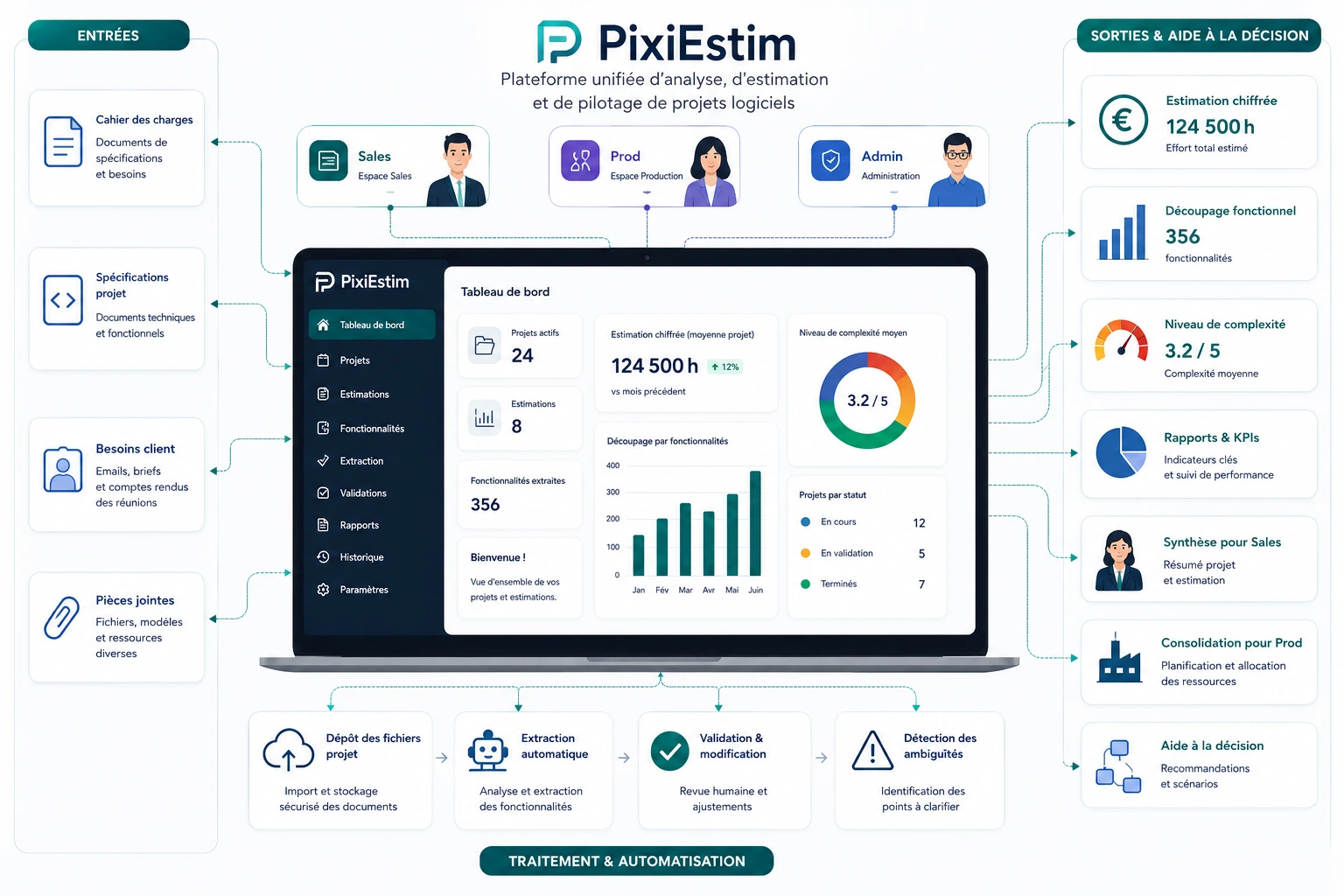
An intelligent software project estimation platform that transforms heterogeneous project documents into structured, AI-assisted software estimations through controlled LLM workflows, historical RAG context, deterministic business rules, and human validation.
Role
Software Engineer — Full-Stack & Applied AI
Technologies
The problem
Software project estimation at PixiMind relied heavily on manually reading heterogeneous requirements documents, identifying functional requirements, selecting the appropriate estimation scales, evaluating implementation complexity, and consolidating effort estimates. The process could become time-consuming, difficult to standardize, and strongly dependent on the experience of the people involved, especially when documents were large, incomplete, or ambiguous.
The solution
PixiEstim centralizes the software estimation workflow in a single platform. Project documents are uploaded and processed asynchronously, converted into structured and context-preserving segments, and analyzed through specialized AI workflows. The system proposes software features, associates validated features with internal estimation scales, evaluates their complexity, enriches decisions with similar historical cases through RAG, converts complexity levels into deterministic effort values, and keeps Sales and Production users in control through explicit human validation stages.
System Architecture
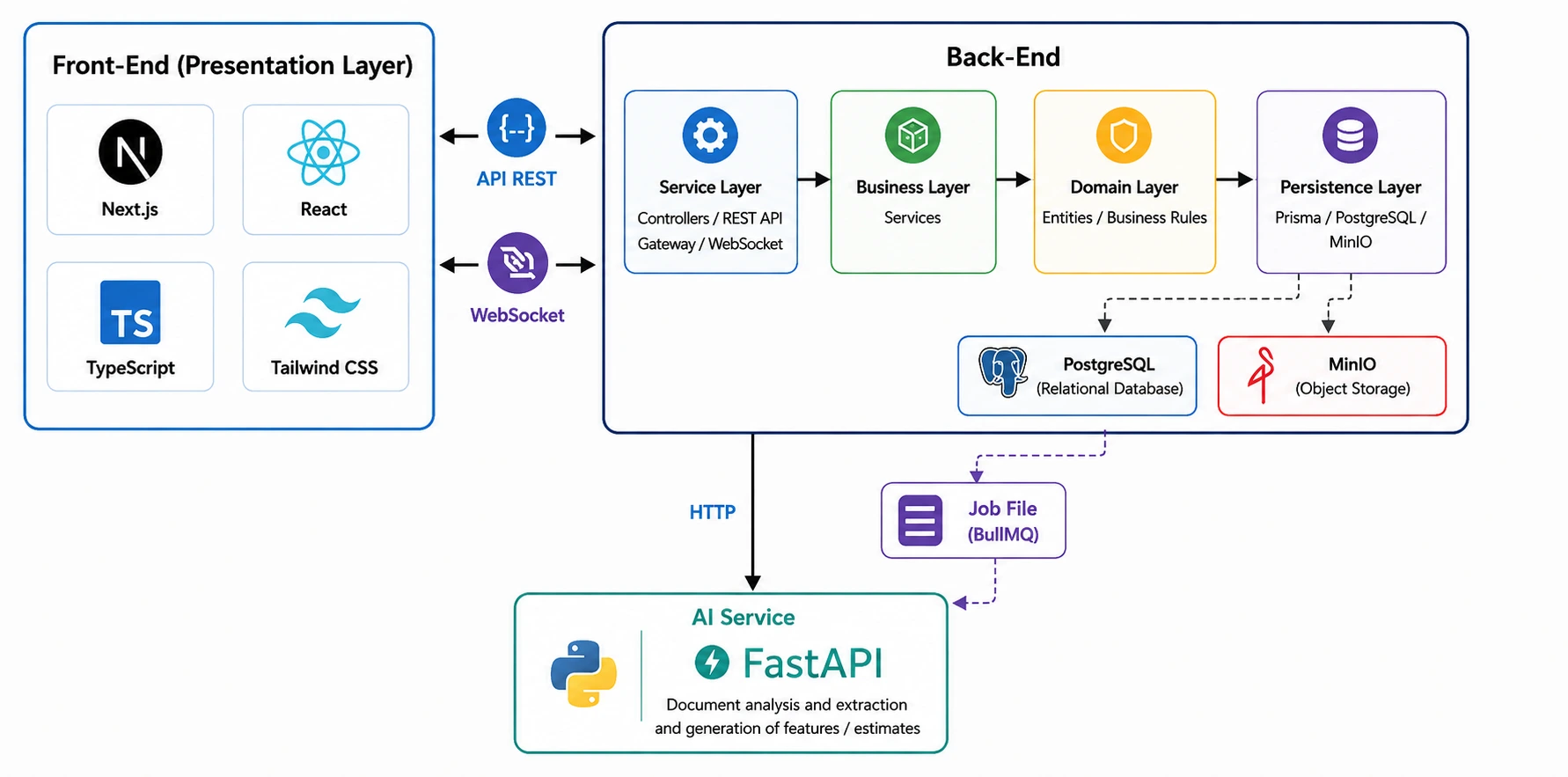
PixiEstim follows a distributed architecture composed of a Next.js frontend, a NestJS backend responsible for business logic, authorization, workflow coordination, and persistence, and a dedicated FastAPI service responsible for document processing and AI orchestration. PostgreSQL and Prisma manage structured business data. Redis and BullMQ support asynchronous processing, MinIO stores uploaded project documents, Qdrant stores and retrieves historical estimation knowledge through vector search, and Ollama provides local LLM inference. The application components are containerized with Docker and integrated into Jenkins-based CI/CD workflows.
Applied AI
AI Engineering
PixiEstim implements a controlled AI workflow rather than delegating the full estimation process to a language model. Each intelligent stage has a specific responsibility, limited context, specialized prompt, expected structured output, application-level validation, fallback rules, traceability, and human validation where required.
AI Pipeline
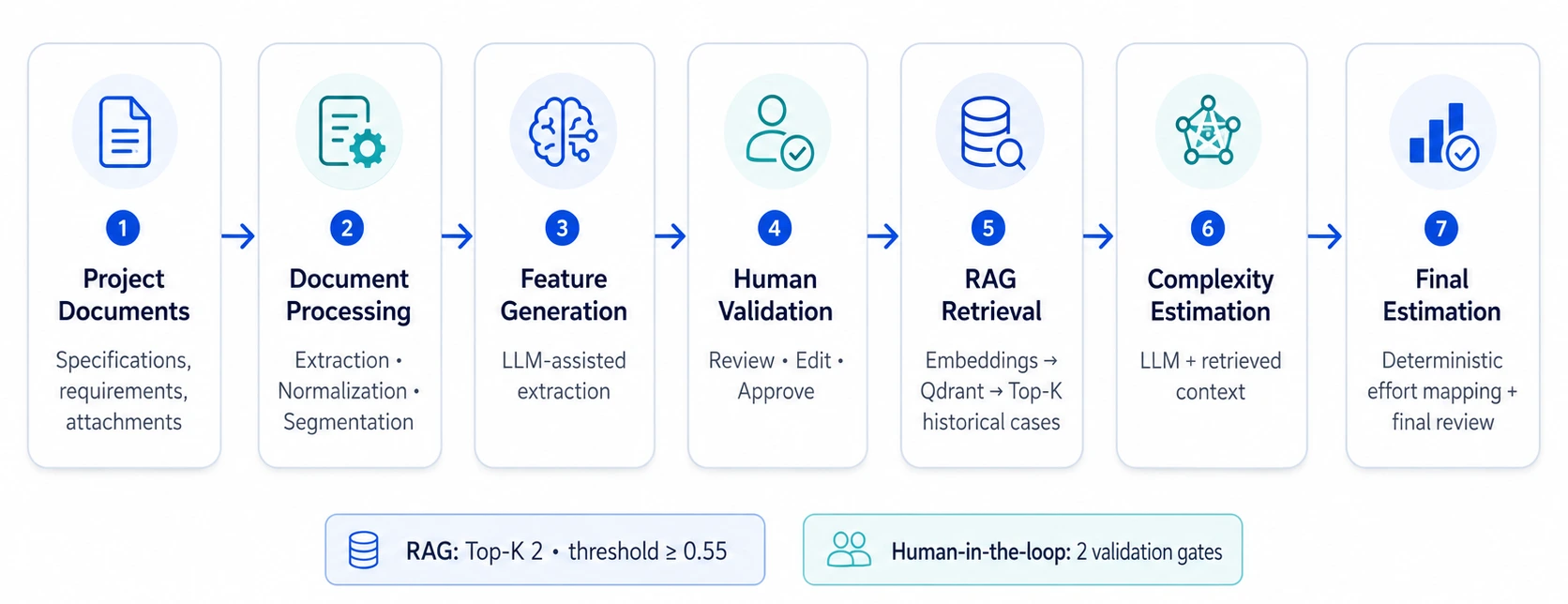
The workflow is decomposed into specialized and independently controlled stages instead of relying on a single end-to-end prompt.
Document ingestion
Project documents are uploaded, stored in MinIO, and submitted to an asynchronous processing workflow instead of being processed directly inside the request lifecycle.
Document extraction
FastAPI retrieves the document, detects its format, selects the appropriate extractor, and converts PDF, DOCX, or TXT content into a common internal representation.
Normalization and reconstruction
Formatting noise and redundant visual information are removed while preserving section hierarchy, reading order, titles, paragraphs, lists, tables, and source provenance.
Contextual segmentation
Large documents are divided along natural document boundaries into context-preserving segments compatible with the local model context window.
Project synthesis
A specialized LLM call creates a global project context from the project name, main document sections, and relevant metadata before detailed feature extraction begins.
Progressive feature extraction
Document segments are processed progressively in batches. Each batch receives the global project context and previously extracted feature titles to preserve coherence and reduce duplication.
Structured output validation
Generated outputs are parsed as JSON and validated against expected fields, formatting rules, closed candidate lists, and application-level constraints before persistence.
Feature deduplication
Generated feature titles are normalized and compared using a configurable similarity mechanism so strongly similar proposals can be consolidated before validation.
Human feature validation
Generated features remain proposals. Authorized users can modify, remove, reorder, correct, or validate them, and only validated features can proceed to estimation.
Estimation-scale association
Validated features are associated with one or more estimation scales selected for the current project. The model can only choose from the closed list of configured scales.
Historical RAG retrieval
For each feature-scale pair, PixiEstim retrieves semantically similar historical estimation cases from Qdrant while applying metadata filtering and relevance controls.
Complexity classification
The model evaluates each feature-scale pair using the current requirement, estimation scale, allowed complexity levels, and retrieved historical references.
Deterministic effort calculation
The LLM does not generate arbitrary effort values. It selects a complexity level, and PixiEstim converts that level into effort using internally configured estimation values.
Human estimation validation
Production users review scale associations, complexity levels, calculated effort, fallback cases, and unassigned features before validating the final estimation.
Prompt Engineering
Task-specific prompts with constrained context, closed candidate sets, explicit rules, and structured outputs.
Project synthesis
Build a global project understanding before detailed analysis.
Output
Structured project summary
Feature extraction
Identify functional requirements from document segments.
Output
Structured JSON list of software features
Scale association
Determine which configured technical estimation scales apply to each validated feature.
Output
JSON associations restricted to authorized project scales
Complexity evaluation
Classify each feature-scale pair according to the allowed complexity scale.
Output
One value from the predefined complexity levels
RAG Engineering
Ground complexity evaluation with comparable historical software estimation cases without treating historical decisions as automatic answers.
Vector DB
Qdrant
Top K
2
Similarity threshold
≥ 0.55
Context
Historical cases
Embedded context
- → Feature name
- → Estimation scale
- → Associated service
- → Concerned part
Stored metadata
- → Historical complexity
- → Reference identifier
- → Estimation scale
- → Associated service
- → Concerned part
- → Embedding/index version
Key RAG decisions
- ✓ Historical complexity is stored as metadata but excluded from the semantic text used to build the search vector.
- ✓ The same embedding configuration and preprocessing are used for indexing and retrieval.
- ✓ References are filtered according to the relevant estimation scale before being added to the prompt.
- ✓ Only references meeting the configured similarity threshold are retained.
- ✓ Historical references are presented to the model as comparison cases rather than answers to reproduce.
Human-in-the-Loop
Human validation is used as a control mechanism at two critical stages of the AI workflow.
Feature validation
Production or authorized users can edit, remove, reorder, deduplicate, and validate generated functional requirements. Only validated features enter the estimation pipeline.
Estimation validation
Users review associated scales, complexity classifications, calculated effort, fallback values, and unassigned features before approving the final estimation.
AI Reliability & Guardrails
Model outputs and retrieved context are validated before they can influence the business workflow.
Risk
Unparsable model response
Control
JSON syntax validation
Behavior
The response is rejected or retried before persistence.
Risk
Incomplete generated element
Control
Schema and required-field validation
Behavior
An invalid element can be discarded while keeping the remaining usable output.
Risk
Duplicate generated features
Control
Normalization and similarity comparison
Behavior
Strongly similar proposals are consolidated before human validation.
Risk
Unknown estimation scale
Control
Closed-list validation against project scales
Behavior
The association is rejected and the affected feature is flagged.
Risk
Invalid or missing complexity
Control
Validation against the predefined five-level complexity scale
Behavior
A technical fallback is applied and the result is explicitly marked for human review.
Risk
Out-of-domain historical reference
Control
Metadata filtering using the estimation scale
Behavior
The reference is excluded before augmented-context construction.
Risk
Low-relevance historical reference
Control
Configurable similarity threshold
Behavior
The reference is not injected into the prompt and its absence remains traceable.
Risk
Excessive RAG context
Control
Top-K result limitation
Behavior
Only the highest-ranked historical references are retained.
Risk
No reliable historical reference
Control
Validation of retrieved-result count
Behavior
The estimation continues without historical context and this execution mode is reported.
Risk
Blind reproduction of a historical estimate
Control
Explicit prompt instruction
Behavior
The model must reason from the current requirement and use historical cases only as comparison evidence.
LLM Observability
Instrumented around the FastAPI orchestration layer.
Support debugging, compare prompt variants, identify slow AI workflow stages, examine retrieval context, detect recurrent failures, and distinguish raw LLM output from data accepted by the application.
Evaluation
No invented metricsOperational observability is implemented, while a formal offline retrieval-quality benchmark is not reported as a completed result.
Currently observable
- ✓ Execution duration
- ✓ Prompt version
- ✓ Model information
- ✓ Raw output versus validated output
- ✓ Retrieved references
- ✓ Retrieval similarity scores
- ✓ Parsing failures
- ✓ Validation failures
- ✓ Fallback usage
- ✓ Token consumption when available
Offline benchmark targets
- → Recall@K
- → MRR
- → RAG versus non-RAG estimation comparison
- → Exact complexity agreement with human validation
- → Within-one-level complexity agreement
- → Structured-output validity rate
- → Fallback rate
- → p50 inference latency
- → p95 inference latency
Technical challenges
- → Processing heterogeneous and potentially large project documents without blocking the main application.
- → Preserving semantic structure and source context while converting PDF, DOCX, and TXT documents into AI-ready representations.
- → Adapting large documents to the limited context window of a locally hosted language model.
- → Extracting coherent software features progressively without losing the global project context.
- → Preventing malformed, incomplete, duplicated, or out-of-domain LLM outputs from entering the business workflow.
- → Associating generated features only with estimation scales authorized for the current project.
- → Retrieving relevant historical examples without introducing unrelated or overly influential references.
- → Keeping AI-generated recommendations under human control throughout feature generation and estimation.
- → Maintaining traceability across document processing, LLM calls, RAG retrieval, validation, fallback, and persistence stages.
- → Coordinating frontend, backend, AI services, PostgreSQL, Redis, BullMQ, MinIO, Qdrant, Ollama, and observability components within one workflow.
Key engineering decisions
- → Separated AI and document-processing responsibilities into a dedicated FastAPI service while keeping business rules, authorization, and persistence inside NestJS.
- → Used Redis and BullMQ for asynchronous processing so document ingestion and AI workloads do not block the main application API.
- → Used MinIO object storage for uploaded project documents instead of storing binary files directly in PostgreSQL.
- → Used PostgreSQL and Prisma for structured business entities such as projects, users, clients, services, estimation scales, features, and estimation history.
- → Converted heterogeneous documents into a common internal representation before AI processing.
- → Used contextual segmentation based on natural document boundaries rather than fixed character-based chunking.
- → Used specialized prompts for project synthesis, feature extraction, scale association, and complexity evaluation instead of one general-purpose prompt.
- → Used structured JSON outputs and application-level validation around LLM responses.
- → Restricted estimation-scale associations and complexity classifications to closed lists of authorized values.
- → Used Qdrant to retrieve semantically similar historical estimation cases.
- → Excluded historical complexity from the embedded search text so the target value does not directly influence semantic similarity.
- → Applied scale-based filtering, Top-K retrieval, and a configurable similarity threshold before injecting historical context.
- → Converted AI-selected complexity levels into effort through deterministic business values instead of allowing the LLM to invent durations.
- → Introduced human validation between feature generation and estimation and again before final estimation approval.
- → Instrumented intelligent workflows through Langfuse to trace prompts, responses, retrieval context, durations, errors, and fallback behavior.
- → Used local inference through Ollama to improve control over confidentiality, external dependencies, and operating costs.
- → Containerized application services with Docker and automated build and deployment workflows through Jenkins.
Results
- ✓ Built an end-to-end workflow from project-document ingestion to validated software effort estimation.
- ✓ Implemented asynchronous document ingestion and processing across NestJS, Redis, BullMQ, MinIO, and FastAPI.
- ✓ Created a document-preparation pipeline covering extraction, normalization, structural reconstruction, contextual segmentation, persistence, and source traceability.
- ✓ Implemented specialized LLM workflows for project synthesis, software-feature extraction, estimation-scale association, and complexity classification.
- ✓ Added structured-output validation, deduplication, fallback handling, and business-rule enforcement around LLM responses.
- ✓ Introduced human-in-the-loop validation before estimation and before final result approval.
- ✓ Implemented deterministic conversion from AI-classified complexity to company-configured effort values.
- ✓ Integrated historical estimation knowledge through a Qdrant-based RAG pipeline.
- ✓ Implemented filtered semantic retrieval with Top-K = 2 and a configurable similarity threshold of 0.55.
- ✓ Added RAG guardrails for domain filtering, low-relevance references, excessive context, missing references, and invalid complexity values.
- ✓ Added observability for AI workflows through Langfuse, including model and prompt information, inputs, raw and validated outputs, durations, retrieval references, similarity scores, errors, and fallback behavior.
- ✓ Containerized the frontend, backend, AI service, and supporting infrastructure and integrated them into Jenkins-based CI/CD workflows.